Thursday, 9 December 2010

Absinthe: strudel, eggs, and molecular mixology


In 2010, I have travelled to Russia, USA, Canada, Singapore, Malaysia, Hong Kong, Switzerland, France, the Czech Republic and the Netherlands. And I have been up and down to London many times too. 11 countries visited, not all on absinthe business, although by early 2011, 9 of them will be selling La Clandestine, Butterfly and other absinthes that I represent.

It's been a very interesting year, during which I have seen other companies joining me in trying to establish an international market for premium quality absinthe, and also seen some of the worst examples of blatant opportunism (not to say, lies and outright deceit) by others who have no love for absinthe and are driven by just the bottom line. In the past, that has led to fake absinthes dominating the sector in countries like the Czech Republic, Russia, Canada, and the UK; so it was especially interesting to see how absinthe is changing in these countries.

In the Czech Republic, absinthe remains largely a drink targeted at tourists and judging by comments read in blogs, on Facebook, on Twitter etc, many people still seem to think that Czech "absinthe" is real, is the "best in the world" and so on. In many cases, it seems that it is not the Czech companies themselves that have managed to con the public so successfully for so long; rather it is their international marketing teams working out of their internet vendors. Forgive me if I don't provide links to their shops again: they don't need any help from me!

In recent years, however, another Czech Absinthe Mafia has started, thanks to the work of Martin Žufánek:

Štefan Habulinec:

and others. Martin is responsible for the launch and development of St. Antoine Absinthe, arguably the best real absinthe to come out of the Czech Republic, and he also imports La Clandestine and Butterfly absinthes into the Czech Republic. I was delighted, therefore, when he invited me to an evening at the main "absinthe shop" in Prague

to meet fellow Absinthe Mafia members and to meet the owner of the shop and of the infamous King of Spirits brand, Pavel Varga, seen here with the famous black cat of Pontarlier:

And what an unforgettable evening it was!

Firstly it would be fair to say that Pavel has not been regarded as a friend of real absinthe. Some of the marketing used to promote King of Spirits has been questionable, and, looking at it positively, such marketing will ensure that the brand will probably never be available widely (if at all) in the USA. However King of Spirits sales online as well as in Russia and the Czech Republic probably compensate Pavel for that. And to give him credit, he is a supporter of real absinthes in his shop as can be seen from the displays there

and at the bar:

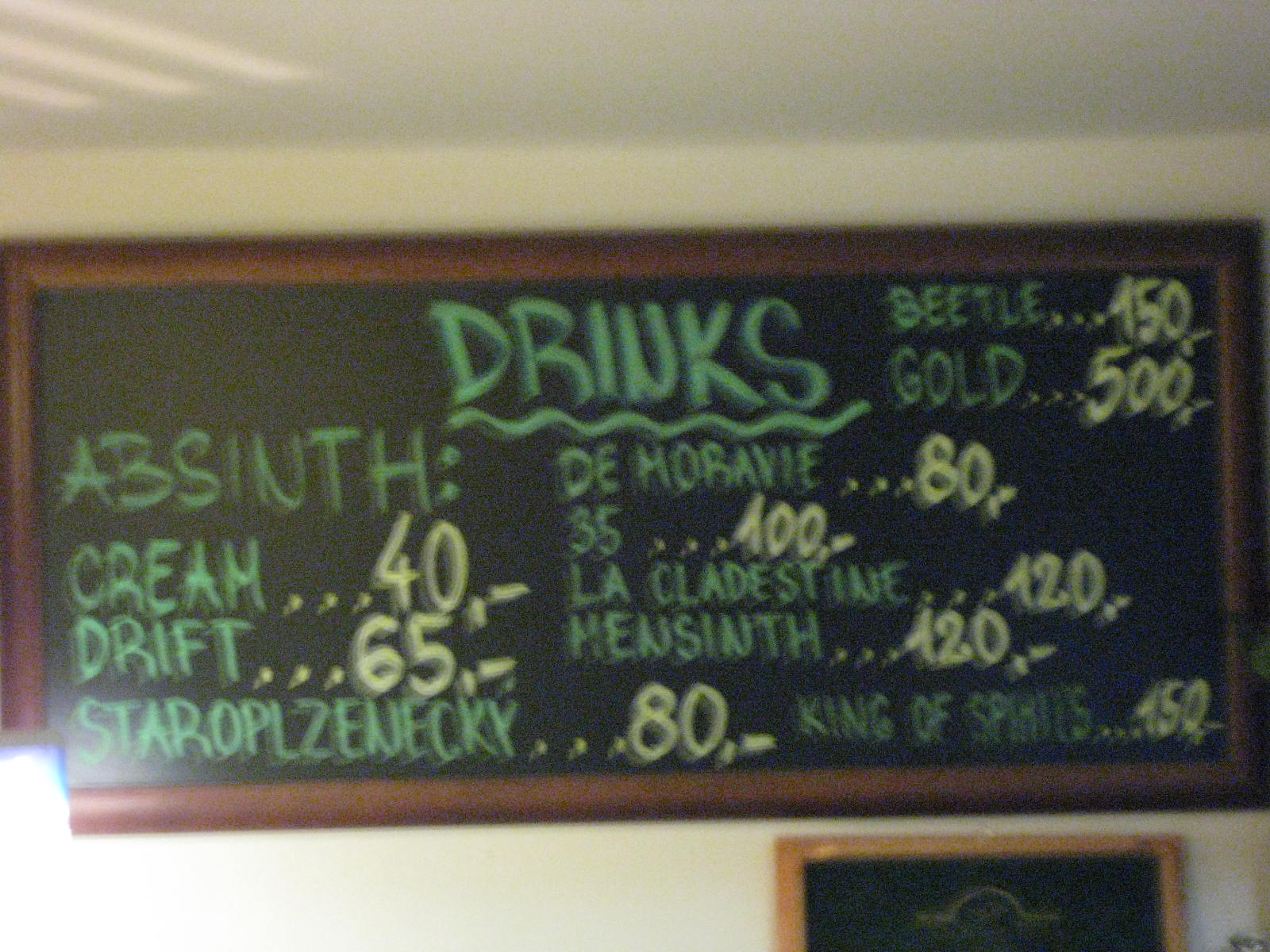
although the shop staff do appear to need better training (judging by their spelling) ...
Pavel allowed us to taste some new distilled absinthes he is developing (good to see and to taste), and he had some nice cocktails to taste. I liked this


which tasted very much like the Apple Strudel my grandmother used to make (maybe just a little too bitter).

Pavel charmed the members of the Absinthe Mafia


and many stayed on into the early hours of the next day. I am pleased to report that almost no absinthe was burned on the night (maybe only the Staroplzenecky), and no blood was spilled. Maybe no conversions to the cause of real absinthe were finalised, but it was certainly a good step in the right direction, judging by Pavel's new absinthes.

On the next day, I had a few minutes of tourism and shopping ...

and then went to some great bars devoted to serving higher quality absinthes. At Hemingway I met Aleš Půta

and Kateřina Kluchová

who made us some excellent Clandestinos and Butterfly Kisses. I loved the jars used for the Clandestinos

and the way that the sprig of mint on the Butterfly Kiss

looked just like a butterfly!

As for the rest of the evening, what happens in Prague stays in Prague. Although now of course, with the work done by Martin and Stefan, some of the absinthe that is drunk in Prague or that leaves Prague is a lot better than in the past!

Fast forward two days and back to the UK where I was lucky to be probably the first person there to taste Claude-Alain's new product ... "Absinthe aux oeufs," which is a kind of absinthe egg-nog.

Currently this is only sold in Switzerland (and mainly at the distillery) because its natural ingredients don't give it a very long shelf-life.

We tasted the Absinthe aux Oeufs two days again later at Purl, one of London's top bars, whose current drinks specials are shown at the top of this article. We agreed that the Absinthe aux Oeufs is an excellent, very complex product, but maybe just a little sweet for some palates (fortunately my wife and I both love it, so more for us!). Purl is a leader in "Molecular Mixology", so it was a real pleasure to watch Tristan Stephenson and his colleagues at work. Tristan shared two cocktails with us, including the Green Fairy Sazerac which is topped with a "Butterfly Absinthe Air." Absinthe lovers tend to be very traditional in their thinking and thus have to respect how a Sazerac is normally made (using an absinthe rinse which is then discarded). How they must hate to do that!

Tristan's take on the Sazerac introduces absinthe at the very end of the process, making it the first thing you taste. The Butterfly Absinthe Air is made using a fish tank aerator


and lecithin to "froth up" the absinthe which is then added as a topping to the final drink.

Of course there is not much absinthe in the finished drink itself, but this process does give the cocktail a good absinthe taste at the beginning of the drink and is an excellent twist on the original Sazerac.

Tristan then shared another absinthe cocktail with us, this time using a very liberal serving of La Clandestine. Since it's not yet on the menu, I won't post too much about it here at this stage but will whet your appetites by saying that it plays with colours as well as with tastes and will certainly prove very popular. Oh, alright, here's a teaser ...


.................................................................

So .. an interesting month in which I've met absinthe lovers in Prague and London, witnessed absinthe drunk the correct way in Prague with the most surprising company, and enjoyed some amazing drinks in both cities. If enjoying absinthe can continue to be developed by the likes of Aleš, Kateřina and Tristan (and if Pavel develops his distilled absinthes), maybe the future of absinthe will indeed be amazing.

Cheers, santé, na zdraví!

Monday, 15 November 2010

Absinthe Cocktails: one more for the road!*


2010 may well be seen as the year that absinthe moved from niche towards (and maybe into) the mainstream. In the USA, competition has stepped up with more companies and brands seeming to get serious about the category, while outside the US more high quality brands have been moving into some new markets.

The growing popularity of good absinthes has been mirrored in the publication of three new absinthe books in the USA. I reviewed The Little Green Book of Absinthe (and the Swiss publication, the Absinthe Cocktail Guide) in March. Then I reviewed A Taste for Absinthe in September. And now, Absinthe Cocktails from Imbibe USA's Kate Simon has been published, this time in both the USA and in the UK.

There are strong similarities between this latest book and Guthrie's A Taste for Absinthe. Both books combine classic cocktails with modern creations. Both books feature cocktails made by many well-known mixologists: Simon includes several cocktails made by some of Europe's mixologists too. As an example, Ales Olasz (who I met last year at London's Montgomery Place) makes a great Reverse Sazerac Sour:

Both books are beautifully photographed: I love this photo from Simon's book showing the Attention as made by Seattle's Jamie Boudreau:

Both books contain an Absinthe Buyers' Guide (as did the Little Green Book of Absinthe). It is very interesting to note that just four absinthes are recommended in all three US guides: La Clandestine and Kübler from Switzerland, Lucid from France, and Obsello (hitherto produced in Spain). Even more interesting to note that Simon's book completely leaves out of her recommendations some of the "absinthes" that were heavily featured in Nathan's Little Green Book. It seeems that the quality message is getting through! And Kate Simon also includes a useful guide to "How to go green without going broke," noting that you could make all 50 cocktails in her book with just one bottle of absinthe.

Absinthe Cocktails and A Taste for Absinthe are clearly the best absinthe cocktail books on the market. I can see A Taste for Absinthe as being a great coffee table book, but it's almost too nice to put too close to the worktop when you're preparing a cocktail. Absinthe Cocktails is more compact and you could take it out with you when bar-hopping. I can imagine going into a bar, pointing at a photo, and saying, "I'll have one of these, please!"

Absinthe Cocktails: 50 ways to mix with the Green Fairy by Kate Simon, is published in the UK by Chronicle at £12.99. All the books mentioned (except for the Swiss book) are available from the major online sellers in both USA and UK. A Taste for Absinthe tends to be more expensive in line with its coffee table appearance; The Litte Green Book is now much cheaper than the others and is also available for the Kindle. Absinthe Cocktails is keenly priced between these two and represents very good value for money, whether you are a long-term absinthe drinker or an absinthe virgin.

It's coming to the end of the working day as I write this ... what better way to mark that than with this from Simon's book: the My Oh My Ty from Brian Miller at Death and Company in New York:

Nice book, Kate! Santé to you and to all those who contributed to it!

* The Real Absinthe Blog wants you to savour your absinthe(s) and to drink responsibly at all times. Good absinthe is made to be savoured and enjoyed ... just like these books!

Sunday, 31 October 2010

Halloween ... and the Corpse Reviver No. 2


A few days ago, I was reading about the Earthquake cocktail(s): at least 3 different cocktails with an absinthe base. On this, it seems that the Savoy Hotel may have ignored the Toulouse-Lautrec version (3 parts of absinthe, 3 parts of cognac) and re-written the cocktail completely for their 1930 Cocktail Book.

Today being Halloween, it seems appropriate to look at another pair of cocktails: the two Corpse Revivers that are both featured in the Savoy book. There is more clarity here, with one being Corpse Reviver No. 1 and the other being Corpse Reviver No. 2. Corpse Reviver No. 1 is made with Italian Vermouth, Apple Brandy or Calvados, and Brandy and the Savoy states, "To be taken before 11 a.m., or whenever steam and energy are needed."

Corpse Reviver No. 2 is a more serious proposition: here are the ingredients as listed in the Savoy.

1/4 Wine Glass Lemon Juice (3/4 oz)
1/4 Wine Glass Kina Lillet. (3/4 oz)
1/4 Wine Glass Cointreau. (3/4 oz)
1/4 Wine Glass Dry Gin. (3/4 oz)
1 Dash Absinthe.

Shake well and strain into cocktail glass. The book then notes:-

"Four of these taken in quick succession will unrevive the corpse again."

This version is thoroughly written up and discussed on the Underhill-Lounge blog, and also appears in the two new Absinthe cocktail books published this autumn: A Taste for Absinthe and Absinthe Cocktails. One of only seven cocktails written up in both books, this is obviously an important absinthe cocktail (incidentally these books define the dash of absinthe as being four or eight drops).

It's also a favourite of absinthe bloggers such as Stijn in Belgium, and of bars around the world such as the prize-winning Bramble Bar in Edinburgh whose Corpse Reviver no. 2 is made with "Zuidam Genever, Cointreau, Lillet Blanc, freshly squeezed lemon juice and Clandestine Absinthe."

I made it using an old, no longer available gin (Gloag's from the makers of Famous Grouse), Combier Triple Sec, Noilly Prat and 8 drops of La Clandestine. And slightly less lemon juice than recommended. It's a very enjoyable and refreshing pick me up.

So for Halloween brunch or lunch, what better way to start the day or to get it going than with this wonderful cocktail!

Thanks to Stijn for the picture at the top. And cheers from your friendly blogger!

Saturday, 16 October 2010

Absinthe in the UK: Part 2

100 years ago this month, absinthe was banned in Switzerland. Over the next few years, bans followed in many other countries, but not in the UK. So 20 years later, the Savoy Hotel was still offering over 100 cocktails that contained absinthe, according to the 1930 Savoy Hotel Cocktail book (did they import large stocks when it was banned or were they importing from Spain?). In fact, the Savoy Hotel has just re-opened in London, but that's another story ...

I have recently written about the absinthe renaissance in the UK, so what better bar to choose for the introduction of La Clandestine, Angélique and Butterfly absinthes than Purl, London: appropriate because it is a bar that looks both back in time and into the future. Purl is a speakeasy-style bar, just off Baker Street that opened in 2010 to some great reviews, including ones from Yet Another Gin, Gin Monkey, and the London Cocktail Guide.

The bar's website states “The name Purl comes from a 19th century beverage that was commonly sold on the streets of London. The drink consists of warm ale, gin and spices. It’s in keeping with our theme of late 19th century birth of cocktails along with pre-prohibition cocktail culture and the art deco period… plus Purl is a nice word (it’s also the sound that water makes when it flows over rocks). Contrary to the vintage drinking era that Purl will typify, the cocktail list will be an ever-evolving mixture of hard core classics and forward thinking sensory peculiarities. You’ll have to pop on down to find out more, but we will be incorporating foams, caviar, homemade infusions, home-aged bitters, ice carving and even liquid nitrogen.”

In fact, according to Wikipedia, Purl was originally a wormwood ale! Another great reason to introduce three absinthes here. It being London Cocktail Week (with many other seminars and events to attend), we decided to drink just two of the absinthes, both in the classic way and in one cocktail each.

It was great to discover that Andreas, shown here making the Clandestino (or Clandestine Caipirinha),


had already visited the Clandestine distillery in 2007, so knew it already.

I was delighted that five highly informed drinks bloggers were able to come along to be part of the absinthe renaissance. They seemed to find the Clandestino (previously described here) a very interesting drink with at least two of them tweeting about it the next day, and they were also pleasantly surprised by the Butterfly Kiss.


Here's the Butterfly Kiss recipe:

1 oz Butterfly Absinthe
1/2 oz Cream
1 oz Honey Syrup (see recipe below)

Shake in a cocktail shaker over ice and serve in a cocktail glass. Garnish with a sprig of mint.

(Honey Syrup:

1 cup Honey
1 cup Hot Water

In a jar, combine the honey with the hot water. Close tightly and shake
the mixture well. You can refrigerate and keep the honey syrup for up to 1 month).

I enjoyed meeting the bloggers (it is ALWAYS nice to meet a fellow-blogger) who had some good questions, and who certainly saw the opportunity for higher quality absinthes in the UK. We didn't taste other absinthes but we agreed that London was ready for much better absinthe than can generally be found there. Now the real work starts for me and my colleagues at distillnation! Time to stop enjoying ourselves

and time to start taking the "real absinthe" message elsewhere!

I started this article by mentioning the Swiss ban that led directly to the underground absinthe movement in the Val-de-Travers in Switzerland, Interestingly, the family of Charlotte Vaucher, the moonshiner who created the recipe for La Clandestine, recently published a blog article about her. It's a fascinating story of family secrets, locked doors, and the determination that kept the absinthe fairy alive, underground, in one small area of Switzerland while it was almost dead everywhere else. A translation can now be read here.

Today is also the 156th anniversary of the birth of absinthe-lover, Oscar Wilde. He would have loved Purl (the bar, more than the historic wormwood ale), and he might have appreciated the absinthes we shared there too.

From Purl in London, a bar that is underground, traditional and yet also ground-breaking, it seeems very appropriate to toast you both today, Charlotte and Oscar. Santé!

Friday, 24 September 2010

A Taste for Absinthe


I wrote about absinthe cocktail books just over six months ago, and at that time there were only a few such books around.

As we approach the holiday season, things are hotting up with at least two new absinthe cocktail books being launched. The first one, A Taste for Absinthe, written by R. Winston Guthrie with James F. Thompson, has just been launched in North America, and it's a clear step up from the books I reviewed six months ago.

R. Winston Guthrie is an absinthe expert and the founder of The Absinthe Buyers Guide. The Guide itself is a litte out-of-date for Americans (with very little on the current absinthe scene in the USA, whether it be absinthe made in the USA or absinthe sold in bars and stores in the USA): however Winston tells me that the Guide will be updated to reflect both the current US market and European absinthes. His book is already up-to-date and thus very relevant for US readers. It is very much "born in the USA," with absinthe and absinthe cocktails as found across the USA today.

Initial impressions of the book are that it is very well produced and excellent value for money. Great photography (by Liza Gershman) with photos of cocktails made by many of America's finest cocktail makers:

Jeff Hollinger from Absinthe Brasserie and Bar, San Francisco

Ryan Fitzgerald of San Francisco, making the Hermitage, blending mezcal, maraschino, Dubonnet rouge, grapefruit bitters and absinthe.

Mae Lane from Griffou

Others have commented on Amazon on the recipes themselves as being quite complex, calling for many different ingredients. I calculated that I could probably make around 20 of the 65 cocktails at home now, and I think my cocktail cabinet is about "average" (for an absinthe drinker, that is). In fact, I think it's much more interesting to have "aspirational" cocktails to work to; ones where I have to get an additional ingredient or two. I like the fact that many different mixologists have provided cocktails; I also like it that Winston often indicates where a blanche or a verte is called for (as opposed to always saying "1 ounce of absinthe").

In addition to the cocktails themselves, there is a fair amount of additional information. Nothing very new for those who know their absinthe, but useful - and accurate - for beginners.

And for beginners, the 10 page Buyers Guide at the end is very different from the website with only current US available brands listed (except for one that is in the process of being approved). Winston is tougher in his brand list than Paul Nathan was in his absinthe cocktail book (The Little Green Book of Absinthe): he leaves out Le Tourment Vert and some Bohemian "absinths" not yet available in the USA. Of the 18 brands reviewed, 14 are stocked in Drink Up New York, demonstrating a good quality bias in Winston's selection. Here's one of the reviews:


A Taste for Absinthe is now available from Amazon USA, Amazon Canada, and Amazon UK (as an import?). It would make a very good gift for both current absinthe drinkers and for beginners. If you do buy it as a gift, beware: you may find yourself using the book before you've wrapped it.

Thanks to Winston and to all those who contributed to the book. It must have been tough work, but it was definitely worthwhile. Santé!

Friday, 17 September 2010

Absinthe in the UK


There's a well-known saying in London about buses: you wait hours for a bus and then three (or more) come along at the same time.

It now appears that this could be true of real, higher quality absinthe with several good - or very good - absinthes all hitting the UK market at the same time.

Industry experts have previously quoted the UK (and Canadian) absinthe market as being effectively still-born with a plethora of "absinthes" on the market with artificial colouring and/or pre-sweetened and/or made using a cold mix system. Co-incidentally the BBC has just aired a programme about so-called nasty ingredients in drinks. So the time appears right in the UK for absinthes that are made to much higher standards, with no artificial colourings etc and with support that focuses on quality, bar staff training, consumer re-education etc.

Of course there are some good absinthes in the UK already, but most are in fairly limited distribution. That's why the news of at least four good absinthes coming to the UK or ramping up their current operations is of great interest.

First out of the blocks and from Switzerland is La Clandestine: first in as much as it has been in limited distribution in the UK up to now.

La Clandestine is probably already known to many of my readers, given my involvement with the brand. So little to more to say, except that I personally see a great opportunity for La Clandestine and the other three newer absinthes to come to the UK.

Next comes Lucid, the first absinthe launched in the USA since prohibition.


Ted Breaux and Jared Gurfein of Viridian Spirits (who are also responsible for La Clandestine in the USA) were recently on a whistlestop tour of London to launch Lucid and it will be fascinating to watch its progress in a new market.

Next up is Maison Fontaine, a new ultra-premium blanche absinthe, made by French distiller Emile Pernot, and the first product from a new company, Metropolitan Spirits.


I enjoyed meeting Sven Olsen, their CEO, in Hong Kong and in Switzerland, and am looking forward to seeing him and Maison Fontaine in London!

Last, but by no means least, is Butterfly. An absinthe that, somewhat paradoxically, is both old and new. Born in Boston in 1902, and now made by the distiller of La Clandestine in Switzerland.


I will relate more of the Butterfly story at a later date: readers interested to know more now may like to read my interview with Brian Fernald, the American from Boston who is behind its renaissance.

As the writer behind the Real Absinthe blog, I am delighted that four very real absinthes will be making waves in the UK over the next few months and beyond. It's good news for absinthe, it's great news for bars who want to experiment with absinthe, and it's wonderful news for UK consumers who have not had so much choice in the past.

Santé to all four absinthes and to those responsible for bringing them to the UK!

And, just a few months later, bars in London are started to have absinthes lists like this (from 22 Below, near Carnaby St.):


Update: To keep up with news and information about absinthe specifically in the UK, there's a new Facebook page intended just for that. Cheers!

Sunday, 11 July 2010

Soccer ... absinthe ... what's the connection?

For the last month, hundreds of millions of people all over the world have been watching one of the biggest sporting events in the world: the FIFA World Cup in South Africa.

There may seem to be little or no connection between this and absinthe, but as the tournament has progressed I have noted links between one world and another.

Early on in the tournament I tweeted about the best absinthe distillers in the world (the Swiss) playing the best footballers in the world (Spain) and speculating that the half-time oranges should be replaced by absinthe. Evidently that happened, since, in one of the biggest upsets in the World Cup, Switzerland won (unfortunately that was their only victory).

If Switzerland was the birthplace of absinthe, then the French can claim to have made it popular during the 19th century. This resulted ultimately in the biggest hangover ever when the French went from feast to famine and banned absinthe in 1915. France suffered another major hangover when their soccer team self-destructed in the World Cup.

England was the birthplace of soccer, is home to at least one absinthe company (although very little absinthe is made in England), and has the distinction of one of the most famous cocktail books. The 1930 Savoy Cocktail Book has 104 cocktails which contain absinthe. As an Englishman, it pains me to say that their soccer team was swept away almost as comprehensively as the Savoy Hotel has moved away from absinthe over the years.

What of the USA? Well, they are clearly an emerging nation in both soccer and absinthe, and maybe 2010 will be seen to be the year in which soccer started to hit the mainstream.

And so to tonight's final. On the one side: Spain, who have always under-achieved in the World Cup before 2010 and whose absinthes have generally disappointed until recently with a preponderance of artifically coloured and sometimes gimmicky products. On the other side: the Netherlands, previously losing finallists and home to a small hand-crafted absinthe business.

The semi-final between Spain and Germany had been the first match I have seen which reminded me not of a cliched chess match, but of a real Spanish bullfight. Beautiful passing and then the clinical finish. The 2010 final started in a similar style but the Dutch forced Spain off the ball and out of their stride (somewhat too forcefully perhaps!). Difficult at times to see who was the matador and who was the bull.

So to the second half. A half of "what ifs." "What if" one of Robben's breakthrough runs had not been saved? "What if" the Ramos header had been a little lower? And more yellow cards, especially for the Dutch.

And then the drama of extra time. A Dutch sending-off .. and it could have been two. And then, deep into the second period of extra time, the matador's stab from Spain's Iniesta! Olé!

I have talked about the Spain-Germany semi-final and the final reminding me of bull-fights. Hemingway wrote about bull-fights in his classic book, Death in the Afternoon. Because of Hemingway's love of both absinthe and champagne, this has become the name of this classic cocktail. What better way then to celebrate Spain's victory?

Friday, 21 May 2010

Absinthe Dinner in Malaysia

Many potential buyers and many potential consumers have a fixed idea about what absinthe is. They think it may be dangerous, that it may attract the wrong sort of customers, that people abuse it. Well, think again. Last night I celebrated a Malaysian Decadent Affair with seven different absinthe drinks before, during and after dinner at the Vanity Restaurant in Kuala Lumpur. This was exciting for me since I lived in Malaysia from 1999 to 2002, and had experienced wine, champagne and cognac dinners there previously.

But absinthe? Did it work? A resounding yes!

Here's a quick look at some of my pictures and some of Angela's (thank you!). The team at work setting up beforehand:

The menu:

The pre-dinner apéritif, La Clandestine Absinthe and Monin Peach:

The Perroquet: Angélique Absinthe, Monin Green Mint and chilled water:

This accompanied an oyster dish (photo to follow). The Clandestine Caipirinha:

accompanying Ricotta cheese stuffed ravioli fresh & dried tomato & lemon olive oil.

Death in the Afternoon:

which went very well with Warm hickory smoke salmon with chat potato dill creme fraiche & salad:

Classic fountain-served Angélique absinthe complemented the Casserole de Poulet with pan fried spatzle, glazed shallot & carrot:

A triple bill of shooters (White Chocolate, La Clandestine, Baileys and Caramel, and Dark Chocolate) was astonishing:

And the evening concluded with the Asian premiere of a barrel-aged La Clandestine. After 40 months, it is taking on some wonderful exotic notes, but this is not yet being sold anywhere in the world.

I was delighted to meet old friends and new, including Malaysia's own Thirsty Blogger:

I was delighted when one of the diners told me afterwards that this event totally changed perceptions of absinthe. Mission accomplished!

Do any of my readers have experiences of absinthe and food they would like to share?

Wednesday, 5 May 2010

For Cinco de Mayo: Tequila .. and Absinthe!

May 5th was not always connected with Tequila. It was originally a voluntary holiday that commemorated the Mexican army's unlikely victory over French forces at the Battle of Puebla on May 5, 1862.

148 years later, it has become a big Tequila day, especially in the USA. I'm fortunate enough to have done some work on Tequilas earlier in my career, and have worked a little on Don Julio (UK and South Asia), Jose Cuervo and 1800 (S.E. Asia and Korea), and Cabo Wabo (UK, Russia, and Australia). Interesting brands indeed. Like absinthe, Tequila has had a "bad boy" image, so it's fascinating to see how the development of ultra-premium tequilas has helped it to become a much more sophisticated drink over the last 10 years.

I am especially delighted, therefore, that while working on absinthe, mixologists have proposed cocktails combining tequila and absinthe. Here are two of them:

The Green Devil (created by Ben Foote, The Bitter Bar)


1.5 oz. Chamucos Reposado Tequila
0.75 oz. Luxardo Limoncello Liqueur
0.25 oz. La Clandestine Absinthe
3-4 leaves of Fresh Thai Basil

*Muddle basil in a mixing glass first, then add all other ingredients with ice... shake for 5-10 seconds, double strain into a chilled cocktail glass. 
**Garnish with a lemon wheel and a sprig of thai basil.

This was created at the Bitter Bar, Boulder which was then under the supervision of James Lee, named then one of the top 10 mixologists in the country by Playboy Magazine. (Update 2014: James has recently returned as owner of the Bitter Bar).

James and I had corresponded on Twitter, and a few weeks later he sent me details of this cocktail and some additional comments. Over to you, James: 

"The Green Devil was our number one selling cocktail when the Bitter Bar opened last year around this time... We tried many different Limoncellos, but decided the Luxardo came through with better balance and not over the top with citrus flavor profile in the cocktail. Also, and more importantly, we ended up switching to La Clandestine from a verte absinthe due to its softer and smoother profile in the cocktail (especially on the nose and start of the drink..). We just did a "rinse" of verte absinthe in the original version of this cocktail due to strong/heavy profile of absinthe/anise flavor, but now we have La Clandestine/blanche in the cocktail, we use 0.25 oz. in the recipe to enhance and made everyone happy with our cocktail!"

.............................................................................................

Clandestine Luna (created by George Delgado of Promixology)

1 oz. La Clandestine Absinthe
1 oz. 100% Cabo Wabo Blanco Tequila
1 oz. Combier
Splash of orange juice
Splash of simple syrup
Garnish = Orange Wheel

Glassware = Martini Glass
Finished with a dash of Blue Curacao into finished drink

In an ice-filled mixing glass or shaker, add La Clandestine Absinthe, the Tequila, and the Combier with the splash of orange juice and the splash of simple syrup. Shake vigorously until shaker gets ice cold. Strain into the Martini glass. NOW add the drop or two of Blue Curacao - it will sink to the bottom to form a “layer”. Put an orange wheel on the rim, or a very thinly sliced orange wheel floating in the drink.

If anyone has any other cocktails that combine tequila and absinthe, I'd love to see them. In the meantime, enjoy the Cinco de Mayo, but not too much. Salud!