Showing posts with label bars. Show all posts

Monday, 25 February 2019

In search of the Bloody Fairy


Virginia Davis, manager, Pirate’s Alley Café/Absinthe House, New Orleans

The ”Bloody Fairy?” Gimmick or classic? Let’s explore this..

By “Bloody Fairy,” of course, I mean an absinthe equivalent of the “Bloody Mary.” Sounds simple, or so I thought.

But it turns out that there are different directions this could go: it could be a standard spicy Bloody Mary with a few dashes of absinthe as seen here:


Or it could be a completely different (and not spicy) drink using absinthe, cranberry juice and tonic water as seen here:


Or it could be a drink in which absinthe completely replaces vodka as mentioned here:


I believe the last option included here fits far better with the "Bloody" proposition and is clearly more "Fairy" related.

I used this starting point on my 2018 visit to New Orleans and later at home. I now believe I am close to the perfect Bloody Fairy, loved by bars, using tweaks from famous cocktail experts, and indulging my own preferences too. It’s been a tough journey but someone had to do it!

Firstly I see little need to tamper with the "Bloody" element, For bars serving very spicy or alternatively more mellow Bloody Marys, you know what works for your customers, so don’t tamper with that element. That’s what your customers want, whether it be a brunch cocktail, aperitif or even digestif (a good Bloody Mary can indeed be all of these). So I will not detail or define here the spicy tomato element of this cocktail: what works for your customers in your bar or for you at home in a Bloody Mary will work for you in a Bloody Fairy.

Moving onto the absinthe element, it is clear that absinthe can be a polarising taste. While vodka can be somewhat blander. I believe less bitter absinthes work much better in this cocktail, complementing the tomato juice and the spicy elements, rather than fighting with them. For me, and the New Orleans bartenders we tried this with, Butterfly Classic Absinthe worked really well, with respectable strength (65%), little bitterness, and a flavour profile that complements tomato and spices. Butterfly has a traditional recipe base of herbs and spices which complement the spices used in Bloody Mary; it also has hints of citrus and mint that sit well alongside tomato juice.

Butterfly's US heritage makes it a perfect ingredient in this Bloody Mary twist, given that the Bloody Mary may have been born at the New York Bar in Paris in 1921 or in New York itself in the 1930's, and it is certainly a cocktail which is most popular in the USA.

So this was the start of the drink: a traditional tomato/spice mix and Butterfly Absinthe. A prototype Bloody Fairy that I drank in bars in New Orleans in September 2018. Firstly in The Old Absinthe House with Jackie and her team:


(yes, I know the Bloody Fairy glass is empty: a clear indication that this was the most popular of the three cocktails we shared)

at other bars around New Orleans:


and at Tony Seville's Pirate's Alley Café and Absinthe House (see photo with Virginia Davis at the top). We all loved it.

However I recognise that the slight element of bitterness in any good absinthe may not work for everyone, and after consideration I realised that an extra ingredient I had enjoyed in Bloody Marys a few years ago would really be the icing on the cake,

Sherry.

I researched further and I found that some of the world’s most celebrated cocktail experts have used sherry to complete their Bloody Marys. If this idea is good enough for Erik Lorincz (formerly of The Savoy)


and for Simon Ford of Ford's Gin


there must be a reason.

Manzanilla or Fino didn’t seem quite right, so I was interested to consider a cream sherry. I was not alone, judging by this article from a British newspaper:


So there we have it. The perfect Bloody Fairy recipe:-

1. Tomato juice and all the usual spices and garnishes: exactly how you would combine them in your Bloody Mary.

2. Spirit:

Either replace all the vodka with Butterfly Absinthe, an American-style absinthe. Noting that this comes in at 65% alcohol, then you could perhaps reduce the amount of absinthe to around two-thirds of the amount (of vodka) you would use in a Bloody Mary.

Or replace half of the vodka with  Butterfly Absinthe, so a smaller amount of Butterfly and half of the vodka.

3. The icing on the cake: float Cream Sherry on top.


We hope you love this Bloody Fairy as much as we do! It is much much more than a gimmick and deserves to become a new classic cocktail. And, as it's Oscar season, I'd like to thank Bernie for all her help in New Orleans and for sharing a few Bloody Fairies! Cheers!

Thursday, 30 October 2014

Absinthe Cocktails Competition in UK


For the last year or so, my bartender presentations on absinthe have included much more about the role of absinthe in cocktails. Absinthe was first distilled commercially in 1798 (in Couvet, Switzerland) and  1798 is also the year that the word "cocktail" first appeared in print meaning a drink. Absinthe and cocktails seem to have been "paired at birth."

Around the world, bartenders now seem to realize that a lot of the old stories and ways of drinking absinthe were myths and fabrications to prey on the ignorant. But some bartenders still don't seem to know what to do with absinthe (apart from rinses in Sazeracs and dashes in Corpse Revivers, that is).

So I was delighted when James Fowler contacted me about an opportunity to talk about absinthe in cocktails with the Bournemouth Bartenders League (BBL). James will be well-known to regular readers here as the owner of The Larder House (home of the first UK absinthe dinner) and more recently the UK winner of Diageo's World Class Bartender competition. I don't know whether there is "something in the water" around Bournemouth or whether it is the inspiration of people like James, but it is clear that there is a lot of bartending expertise there. James put me in touch with Salvatore Damiano of the BBL and a few weeks later, I drove to The Larder House and I gave a short presentation about absinthe in cocktails (with the behind-the-bar help of Franco) ...


I have no idea what I was doing with the iPad in that top right shot, but by the time of the bottom right shot, I had finished my talk and was enjoying watching the cream of local bartenders at work. Why? Well, I have spent far too much time in the last year or so analysing history, the ways in which absinthe was used in cocktails back in the days of Harry Craddock at The Savoy (1930), and how modern bartenders are now using absinthe. For example ...


The first column of numbers shows the % of absinthe cocktails which used specific other ingredients in The Savoy in 1930. Not surprisingly absinthe was used in a lot of cocktails with gin and/or vermouth. The second column of numbers is based on the best absinthe cocktails book, A Taste for Absinthe, published in 2010, with cocktails provided by many of the world's best bartenders. Gin and vermouth have slipped down the list, and lemon/lime along with sugar or simple syrup have become the most popular ingredients to be paired with absinthe in cocktails.

Interestingly both La Clandestine and Pernod are working extensively with cocktails made almost entirely with absinthe, limes and sugar. The Clandestino was first made in 2007 and The Green Beast was first made about three years later.

So why was I at the Larder House? Here there was a team of contestants who were not thinking of the 1930 or even of 2010. They were thinking of creating the next great absinthe cocktail. Their brief was to use a full measure of absinthe, either La Clandestine or Butterfly, in creating their own new cocktail, and here is what they created and what I had the pleasure of judging ..

1. David Hall, Urban Reef
The Boston Cocktail

25ml Butterfly Absinthe
25ml Green Apple syrup
75ml Water
4 dashes of Orange bitters
Shaken and pour in a tumbler


I loved the way that David took elements from Butterfly's past: especially the fact that the owner of Dempsey, Boston, was one of the major US players fighting the threat of prohibition.


2. Connor Sanderson, The Captain's Club Hotel
Alice's Fairy Elixir

25ml La Clandestine
15ml Koku Kanu
15ml Mozart white liqueur
1 egg white
A spoon of New Forest Strawberry Jam
Nutmeg
Shaken and pour over crushed ice in a jam jar


Beautifully made with some great ingredients; excellently presented.

3. Harry King, The Library at The Larder House
Parasite

20ml Butterfly absinthe
10ml Creme de Violette
10ml Kamm and Sons aperitif
5ml maraschino
20ml lime juice
Stirred over ice and topped with elderflower tonic water and finished with a lavender foam


The foam was an interesting challenge for a judge; of course one has to taste through it too, in order to understand how the taste of the cocktail will develop. The one small issue I had with this cocktail was the name which didn't quite communicate how wonderful this cocktail was.

4. Thomas Quy, The Captain's Club Hotel
Fancy a Cuppa

40ml Butterfly Absinthe
20ml lemon & ginger tea syrup with mint
15ml lemon juice
20ml Violet Liqueur
2 dashes of grapefruit bitters
Shaken and poured into a tea cup


A very full measure of Butterfly here: 40 ml. Great taste and presentation. This is getting difficult ...  

5. Joel Whitmore, The Larder House
Covert Beets in the Back Streets of Couvet

Per serving –
40ml Apple & Ginger Juice
20ml Beetroot Juice
0.1g malic acid
Pour all ingredients into iced filled absinthe fountain.
Stir. 
Add 25ml La Clandestine Absinthe into Absinthe glass.
Turn taps and add desired amount of apple and beet mix to absinthe. 
Garnish with Swiss mountain flowers.


I had met Joel previously and, honestly, I didn't want him to win if he seemed to have any inside advantage! But I couldn't fault the concept or the final presentation and taste. Absinthe and beetroot do work together well, both visually and in a cocktail. It wasn't the punchiest of names for a cocktail but apart from that, it was faultless.

So I chose two winners: Joel (for the best cocktail with La Clandestine) and Thomas (for the best cocktail with Butterfly).


And I was delighted that Salvatore chose another winner, David, for the Bournemouth Bartenders League prize.


It was a great day for me, in which I learnt a lot about the process of creating cocktails: from naming, through to preparation and execution. Thank you to the Bournemouth Bartenders League, thank you to Matt Pollard for the photographs (hopefully my collages did not spoil them too much!),and above all thanks to Salvatore for organising it all. It is clear that great absinthe cocktails can be made with much more than a few drops or dashes as used by Craddock in 1930. If this happens elsewhere, absinthe distillers will be very busy keeping up with demand in the near future!

Friday, 9 August 2013

Dr. Funk: the Absinthe Tiki cocktail


Another Monday, another great meeting with bar staff, this time at The Hide Bar in London. It's what I like most in this role that I have developed for myself. Well, that and de-flowering absinthe virgins, but that's another story!

I think a good time was had by all: we started with Clandestinos and I saw that Rufus, the founder of the company that owns The Hide Bar was making an interesting absinthe cocktail at home several hours later.

But I was also on a quest to try a tiki cocktail containing absinthe that I had first read about nearly three years ago, and that is the .... Dr. Funk.

I had heard about this from Robert Haynes-Peterson, who is the national Spirits Examiner for the Examiner, and Drinks Examiner for New York. This is the recipe he posted in 2010 in Drinkology for Fashion Forum Magazine:

apparently from Trader Vic's, circa 1947. Well, not the La Clandestine absinthe part of it, which was Robert's suggestion!

Nastassia of The Hide made a Dr. Funk as shown above (but without the chimney glass or garnishes) and we all agreed that it worked very well. The colour is not so "girly," as to put off men, and it's actually quite a sophisticated drink. The general view was that the absinthe worked well; indeed we felt we could have used more absinthe.

There are certain elements of this drink that are interesting. Of course in 1947 there was no absinthe - officially at least in the USA. In fact most most of the online versions of the Dr. Funk recipe from around this time do seem to specify either Pernod (pastis) or Herbsaint. More significantly they - and most subsequent recipes - contain a lot more rum than absinthe/pastis. Typically a 5:1 ratio, while we were drinking a 2:1 recipe. Here's the one from the 1947 Trader Vic's Bar Guide:


It seems that Robert had adapted this original recipe to produce his version of the Dr. Funk, reducing the rum content from 2.5 to 0.5 oz and switching to absinthe and Robert and I agree that his version works really well. (Edit: noting the first comment, the revised version may be a little smaller than some Tiki cocktails. I suggest using the ratios suggested by Robert, but scaled-up as required).

However ... going back into the history of the drink, the first documented recipe reference is from the book "Mystic Isles of the South Seas" (1921) where you can read the following:-

"I had been introduced to a Doctor Funk by Count Polonsky, who told me it was made of a portion of absinthe, a dash of grenadine,—a syrup of the pomegranate fruit,—the juice of two limes, and half a pint of siphon water. Dr. Funk of Samoa, who had been a physician to Robert Louis Stevenson, had left the receipt (sic) for the concoction when he was a guest of the club. One paid half a franc for it, and it would restore self-respect and interest in one's surroundings when even Tahiti rum failed."

In other words, with a full portion of absinthe and with no rum at all, meaning that Robert's version, whether developed consciously or sub-consciously, is a good compromise between the original (1921) and the Trader Vic's (1947) versions!

There's more - much more - on the history of this fascinating and very enjoyable cocktail on the Pegu Blog and at Tiki Central. This time around, I'm going to sit out the talking and get on with making another one for myself. Manuia!

Wednesday, 2 May 2012

The Bartender's Guide to Absinthe


Whenever I get the chance to talk with others about absinthe, then I'll accept the offer, start right away, and it's almost impossible to stop me. It's the part of the "job" (if you can call it a "job") that I like best. It beats selling, it beats paperwork and it certainly beats all those pesky tax returns!

However, one day I may have to face up to the fact that I cannot talk about absinthe with everyone who's interested in it in all of the 25 countries currently selling La Clandestine. And that's not even factoring in my language skills (or lack of). And that is why it's so important that I talk as much as I can with those in the front line for absinthe: bartenders and shop staff.

So today's article is for some of them, and at the risk of offending the shop staff, especially in liquor stores, off-licences, cavistes etc. I'll focus this time on bartenders. Using the term to include bartenders, wait staff, sommeliers, managers and owners and to include staff in bars, clubs, restaurants and hotels. If I say "he," it means "he" or "she" or "they."

Preamble over ... what do bartenders need to know? And what do they need to do to be able to make the most of the absinthe selling opportunity?

1. KNOW THE PRODUCT(S), INCLUDING TOPLINE INFORMATION ON HOW ABSINTHE IS MADE AND WHAT'S IN IT, AND EVEN MORE INFORMATION ON THE CATEGORY'S HISTORY


No need to be too scientific about this: the Wikipedia article is fine.

Distilled absinthe

Distilled absinthe employs a method of production not unlike high quality gin. Botanicals are initially macerated in distilled base alcohol before being redistilled to exclude bitter principles, and impart the desired complexity and texture to the spirit.

The distillation of absinthe first yields a colourless distillate that leaves the alembic at around 72 % ABV. The distillate may be reduced and bottled clear, to produce a Blanche or la Bleue absinthe, or it may be coloured to create a verte using natural or artificial colouring. Traditional absinthes obtain their green colour strictly from the chlorophyll of whole herbs, which is extracted from the plants during the secondary maceration. This step involves steeping plants such as petite wormwood, hyssop, and melissa (among other herbs) in the distillate. Chlorophyll from these herbs is extracted in the process, giving the drink its famous green colour.


The history of absinthe is fascinating and is a key part of why consumers - your customers - are interested to find out about absinthe. You can buy the Absinthe Encyclopedia, read Barnaby Conrad's Absinthe: History in a Bottle shown above, watch the film "Absinthe," or, the best value option (said modestly), even get me along to talk about it. I have addressed the history side of absinthe (along with a few issues resulting from that) in my 10 key facts series on this blog, and that's a big part of what I share with people I meet.

So why is the history so interesting, even more relevant than knowing what's in absinthe? Put simply, and using the words of a former boss of mine: "Sell the sizzle, not the sausage." Your customers are much more interested in everything around absinthe (including the myths and half-truths which you can correct) than knowing every last detail of what's in it.

2. CHOOSE YOUR ABSINTHES WITH CARE

If your bar or restaurant sells a range of single malts, XO Cognac, some 100% blue agave tequilas, and some craft spirits, you can probably consider a range of absinthes to complement the rest of your list. Top bars, especially in Europe, may not always want to carry the absinthe(s) that can be found in every local shop, and with the wide range of absinthes available nowadays you can choose a range that suits your bar, your needs, and your customers' expectations.

As a bare minimum, carry a verte and a blanche. Some customers expect the green fairy to be green or at least "greenish;" others will probably find a good "blanche" to be a softer introduction to absinthe while many bartenders find blanches to be more versatile in a wider range of cocktails (It's not just me saying that: the famous Bariana Guide - the first French cocktail book - recommends blanches over vertes in several of its cocktails).

Develop and segment your absinthe list, either by country or by colour. A country split allows you to tell some of the history about Swiss origins and how Swiss moonshiners kept absinthe alive during the ban; and about French development, the green hour, the artists and the ban. And in some countries such as the USA, you can use a country split to tell the story of a locally made absinthe or two.

Select a range of tastes, from herbaceous to floral, from slightly more bitter to slightly sweeter.

If you only have 3 absinthes, make sure you can explain the differences to your customers. If you stock more than 20 absinthes ... make sure you can explain the differences to your customers!

Absinthes should be a good revenue earner for bars, so it normally makes sense to stock premium quality absinthes, rather than trying to save a few dollars per bottle. Absinthe lovers are loyal to the category, and loyal to the brands they love, so bars can use that to make customers loyal to them too. Absinthe lovers are big spenders, whether buying a traditional serve absinthe or absinthe in a cocktail, so keep them loyal!

3. SERVE ABSINTHE IN UP TO THREE DIFFERENT WAYS: THE PERFECT POUR (Traditional fountain, dripper, carafe method), IN CLASSIC COCKTAILS, AND IN MODERN MIXES.

To repeat that ..

PERFECT POUR
CLASSIC COCKTAILS
MODERN MIXES


The Perfect Pour, serving absinthe the traditional way via a fountain, dripper or carafe, is what your customers who are discovering absinthe want to see. Troy Clarke from the Royal Sonesta, Boston, home of the ArtBar, confirms that the correct serving of absinthe is a key element. The ritual of the absinthe serve conveys all the history in an eye-catching way that will attract other customers in the bar to absinthe. Fountains and drippers are part of that, but what really intrigues customers is watching the "louche," the way the absinthe turns cloudy when chilled water is added slowly.

A carafe (which was evidently good enough for Van Gogh) ...

or a jug (provided it can be used to do a slow pour) can work just as well as a fountain (with less risk of breakage), and ideally your customer should be allowed to add the water himself. Recommend they pour it as slowly as possible, adding too little water to start with (perhaps 3 parts of water with a 53% blanche, 4 or more parts of water with a 65% verte) on the basis that it's easier to add more water, than to take it out! After the first addition of water, they should taste and add more water to find what works for them. Like tea or coffee, we all have different preferences.

Sugar and spoon? They are fun, maybe, but after 8 years tasting lots of absinthes, I've come to the conclusion that most good absinthes don't need sugar, and that sugar is mainly required to paper over the cracks of less good absinthes. Again, that may be more a reflection of my own tastes, but it is generally accepted that the better blanches in particular really don't need sugar (and the same goes for Butterfly).

Classic Cocktails with absinthe, almost all of which are listed here, are a must. One day, a bar will produce a printed cocktail menu offering all 108 cocktails containing absinthe from the 1930 Savoy Hotel Cocktail book (that's a challenge!), but in the meantime, make sure you can offer some of the basics, including

the Sazerac, the Corpse Reviver # 2, the Absinthe Frappée, as well as the slightly more modern
Death in the Afternoon (I am sure good bartenders will be able to work on a much longer list than these basic classics). I also like to see how some bartenders introduce their own personal twist to the classics.

Modern mixes, using ingredients that were rare or even non-existent in the classic cocktail era. Using methods that come from other countries. Using molecular mixology. Drinks such as the Absinthe Mojito. And the Absinthe Caipirinha ... or as I like to call it the Clandestino.


Modern mixes may be how you can make a powerful statement as to what your bar is. They don't have to be over-complicated, and may just capitalise on, for example, the fruit bases that are available nowadays. We have found that some bars love to work with Butterfly Absinthe, because the citrus/mint elements work really well in modern fruit-focused cocktails.

And here is a great way to communicate exactly that three way split of how to offer absinthe from the Onyx Lounge, LA.


4. HANDLING CUSTOMERS WHO KNOW "BETTER"


An interesting topic, raised in the comments by Evan Camomile, another absinthe blogger. As he writes: "One thing every bartender will have to deal with is the customer who erroneously "knows better" and wants absinthe lit on fire or served in a shot." I guess you can add to that list the customer who wants to know the thujone content of an absinthe, and insists that this will influence his/her buying decision. There is a school of thought that says "the customer is always right," but in this instance I feel that a bartender will gain business for his bar in the long run by gently trying to persuade the customer of the error of his ways.

As far as a request for fire is concerned, a bartender could respond "We have a Health and Safety policy of not setting fire to any drinks in our bar, and in any case we believe that a burnt caramel taste does not improve good absinthes. Can we suggest you try absinthe the classic way as it was drunk in the 19th century or in a cocktail?"

Shots? "Absinthe was never made to be drunk as a shot: adding chilled water will give you a drink that will last three or four times as long, and one that almost all of our customers seem to prefer. Could we divide your drink between two glasses, add some chilled water to the second glass and ask you to compare the two different experiences for yourself?"

Thujone? "We do not know the thujone levels of the absinthes we have, and all the research we have done on this suggests it is not really relevant. All our absinthes are within the legal limit, and it really makes no difference to the drink what level it is. You'd have to drink several bottles of absinthe very quickly to get any so-called "absinthe effect," and we'd prefer you not to do that, for your health as much as anything!"

Any other difficult questions from "know it all" customers?

5. FURTHER STUDY!


Absinthe is a relatively new category in most markets, and therefore it presents a great opportunity for progressive bars to be innovative. Here are some ideas for how to capitalise on absinthe in your bar.

Ask an Absinthe Ambassador to run an Absinthe Masterclass in your bar, both for bar staff and for consumers (best run separately). Here is the email address of one Absinthe Ambassador: alanATlaclandestineDOTcom

Run an Absinthe Dinner/Food Pairing event. I've run these in Europe and in Asia, and they can be very effective at shaking up preconceptions of absinthe. The herbal make-up of absinthe probably works better with food than many other spirits.

Serve Absinthe Flights, allowing your customers to sample 3 very different styles. A flight of 3 Vertes from France, Switzerland and the USA. Or of 3 blanches from different countries. Or 3 absinthes from one country. Or a flight of very small batch absinthes from different States/countries. And so on. This seems to be an excellent opportunity to attract consumers to your bar (assuming you're the first to do this in your area) and it's great for customers too.

Apparently, "absinthe makes the heart grow fonder," so celebrate Valentine's Day, host wedding parties etc ... using absinthe.

The whole history of absinthe provides many date-related events to use. The day it was banned, the day it was re-legalised, Van Gogh's birthday, etc etc. The opportunities for promotion are almost limitless.

And I'm sure I'm only scratching the surface here. Let me know if you have any ideas too.

.............................................................................................................

In just a few paragraphs, I cannot claim to provide absolutely everything that a bartender needs to help him use and serve absinthe. Absinthe also needs passion, interest and even love ... and not every bartender will love absinthe. That's precisely the opportunity for those who do love absinthe .. to allow your passion to shine through, and to enthuse your customers. I hope to meet many more of you over the months and years ahead, in North America, in Europe and in Asia. Please feel free to contact me for help, and with any questions. And until we meet face-to-face ... Santé!

Wednesday, 25 January 2012

"Burns Night" or "No burns Night?"


Today is the birthday of the great Scottish poet, Robert Burns, and is the time when Scots around the world, including many living outside Scotland, celebrate "Burns Night." Tonight abundant quantities of haggis, tatties and neeps will be eaten, "washed down" (as Wikipedia puts it) with a few drams of Scotch.

As an Englishman who has sold a few bottles of finest Scotch in his career (including Famous Grouse, The Macallan, Highland Park, Black Bottle etc), I have mixed feelings about the current move towards a vote on Scottish independence. But I am a great fan of Burns Night.

Now, however, I am someone selling a few cases of finest absinthe around the world, and who hates the idea that anyone should try to set fire to absinthe. Something I still see from time to time. although thankfully more often with lower quality absinthes that, arguably, deserve nothing less! So I want to mark Burns Night by declaring that henceforth this night - and hopefully all other nights - shall be "No burns Night" for absinthe (note the small "b" please; there's no anti-Scottish sentiment here). It's time to stop, for once and for all, scenes like this:


"No burns Night" is, of course, more a manifesto of future intent, since we cannot stop all absinthe burning immediately. But to help absinthe drinkers around the world tonight, I wanted to publish a very short list of some of the best bars where they carry a good range of quality absinthes, which they don't burn and hopefully never will. It's just one or two bars in ten or so countries around the world, and I'll be pleased to add the names of any bars that should be included in this list. Please add details in the comments, and I'll post into the main list.

SOME BARS AROUND THE WORLD WHERE THEY DON'T BURN ABSINTHE

ENGLAND

The Soho House Group
Brompton Bar and Grill, London
Nightjar, London
Purl, London

SCOTLAND (not yet a separate country, but listed separately here in honour of Robert Burns!)

Bramble Bar
Bond No. 9, Edinburgh

USA

Maison Premiere, New York
PDT, New York
Chinatown Coffee, Washington DC
Hundreds more bars in New York, California, Louisiana, Texas, Colorado, Kansas, Massacusetts, Rhode Island, etc.

CANADA

Clive's Classic, Victoria, BC
Dieu du Ciel, Montreal

AUSTRALIA

Absinthe Salon, Sydney

JAPAN

Bar Tram, Tokyo

HONG KONG

Blck Brd

MALAYSIA

Sky Bar, KL

SWITZERLAND

Absinthe Bar, Fleurier along with probably every single bar in the Val-de-Travers!
Grune Fee, Solothurn

FRANCE

Antibes Absinthe Bar

CZECH REPUBLIC

Hemingway, Prague

GERMANY

La Petite Absintherie, Leipzig
Sixtina, Leipzig

MANY MORE BARS GLOBALLY, INCLUDING NEW BARS IN THE NETHERLANDS, SINGAPORE, MALAYSIA ETC!

Sadly, Burns died in 1796, just one or two years before the first commercial absinthe distillery was established in Couvet, Switzerland, so he probably never had the chance to taste absinthe. But to him, and to those responsible for the bars listed above, and to all the other non-burning bars too many to name (hopefully an ever-growing list) ... Slàinte! Santé! Cheers!

Thursday, 9 December 2010

Absinthe: strudel, eggs, and molecular mixology


In 2010, I have travelled to Russia, USA, Canada, Singapore, Malaysia, Hong Kong, Switzerland, France, the Czech Republic and the Netherlands. And I have been up and down to London many times too. 11 countries visited, not all on absinthe business, although by early 2011, 9 of them will be selling La Clandestine, Butterfly and other absinthes that I represent.

It's been a very interesting year, during which I have seen other companies joining me in trying to establish an international market for premium quality absinthe, and also seen some of the worst examples of blatant opportunism (not to say, lies and outright deceit) by others who have no love for absinthe and are driven by just the bottom line. In the past, that has led to fake absinthes dominating the sector in countries like the Czech Republic, Russia, Canada, and the UK; so it was especially interesting to see how absinthe is changing in these countries.

In the Czech Republic, absinthe remains largely a drink targeted at tourists and judging by comments read in blogs, on Facebook, on Twitter etc, many people still seem to think that Czech "absinthe" is real, is the "best in the world" and so on. In many cases, it seems that it is not the Czech companies themselves that have managed to con the public so successfully for so long; rather it is their international marketing teams working out of their internet vendors. Forgive me if I don't provide links to their shops again: they don't need any help from me!

In recent years, however, another Czech Absinthe Mafia has started, thanks to the work of Martin Žufánek:

Štefan Habulinec:

and others. Martin is responsible for the launch and development of St. Antoine Absinthe, arguably the best real absinthe to come out of the Czech Republic, and he also imports La Clandestine and Butterfly absinthes into the Czech Republic. I was delighted, therefore, when he invited me to an evening at the main "absinthe shop" in Prague

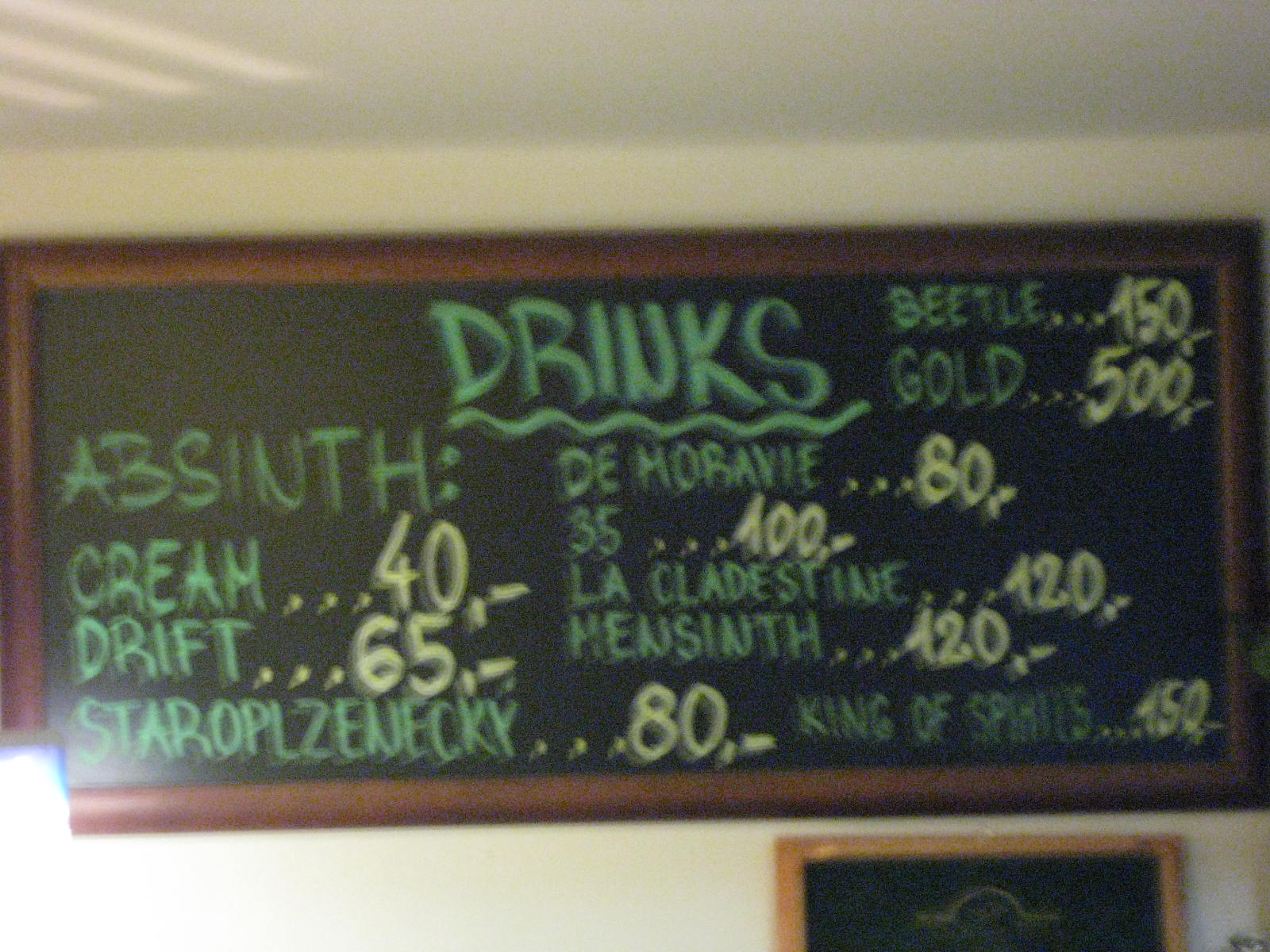
to meet fellow Absinthe Mafia members and to meet the owner of the shop and of the infamous King of Spirits brand, Pavel Varga, seen here with the famous black cat of Pontarlier:

And what an unforgettable evening it was!

Firstly it would be fair to say that Pavel has not been regarded as a friend of real absinthe. Some of the marketing used to promote King of Spirits has been questionable, and, looking at it positively, such marketing will ensure that the brand will probably never be available widely (if at all) in the USA. However King of Spirits sales online as well as in Russia and the Czech Republic probably compensate Pavel for that. And to give him credit, he is a supporter of real absinthes in his shop as can be seen from the displays there

and at the bar:

although the shop staff do appear to need better training (judging by their spelling) ...

Pavel allowed us to taste some new distilled absinthes he is developing (good to see and to taste), and he had some nice cocktails to taste. I liked this


which tasted very much like the Apple Strudel my grandmother used to make (maybe just a little too bitter).

Pavel charmed the members of the Absinthe Mafia


and many stayed on into the early hours of the next day. I am pleased to report that almost no absinthe was burned on the night (maybe only the Staroplzenecky), and no blood was spilled. Maybe no conversions to the cause of real absinthe were finalised, but it was certainly a good step in the right direction, judging by Pavel's new absinthes.

On the next day, I had a few minutes of tourism and shopping ...

and then went to some great bars devoted to serving higher quality absinthes. At Hemingway I met Aleš Půta

and Kateřina Kluchová

who made us some excellent Clandestinos and Butterfly Kisses. I loved the jars used for the Clandestinos

and the way that the sprig of mint on the Butterfly Kiss

looked just like a butterfly!

As for the rest of the evening, what happens in Prague stays in Prague. Although now of course, with the work done by Martin and Stefan, some of the absinthe that is drunk in Prague or that leaves Prague is a lot better than in the past!

Fast forward two days and back to the UK where I was lucky to be probably the first person there to taste Claude-Alain's new product ... "Absinthe aux oeufs," which is a kind of absinthe egg-nog.

Currently this is only sold in Switzerland (and mainly at the distillery) because its natural ingredients don't give it a very long shelf-life.

We tasted the Absinthe aux Oeufs two days again later at Purl, one of London's top bars, whose current drinks specials are shown at the top of this article. We agreed that the Absinthe aux Oeufs is an excellent, very complex product, but maybe just a little sweet for some palates (fortunately my wife and I both love it, so more for us!). Purl is a leader in "Molecular Mixology", so it was a real pleasure to watch Tristan Stephenson and his colleagues at work. Tristan shared two cocktails with us, including the Green Fairy Sazerac which is topped with a "Butterfly Absinthe Air." Absinthe lovers tend to be very traditional in their thinking and thus have to respect how a Sazerac is normally made (using an absinthe rinse which is then discarded). How they must hate to do that!

Tristan's take on the Sazerac introduces absinthe at the very end of the process, making it the first thing you taste. The Butterfly Absinthe Air is made using a fish tank aerator


and lecithin to "froth up" the absinthe which is then added as a topping to the final drink.

Of course there is not much absinthe in the finished drink itself, but this process does give the cocktail a good absinthe taste at the beginning of the drink and is an excellent twist on the original Sazerac.

Tristan then shared another absinthe cocktail with us, this time using a very liberal serving of La Clandestine. Since it's not yet on the menu, I won't post too much about it here at this stage but will whet your appetites by saying that it plays with colours as well as with tastes and will certainly prove very popular. Oh, alright, here's a teaser ...


.................................................................

So .. an interesting month in which I've met absinthe lovers in Prague and London, witnessed absinthe drunk the correct way in Prague with the most surprising company, and enjoyed some amazing drinks in both cities. If enjoying absinthe can continue to be developed by the likes of Aleš, Kateřina and Tristan (and if Pavel develops his distilled absinthes), maybe the future of absinthe will indeed be amazing.

Cheers, santé, na zdraví!